

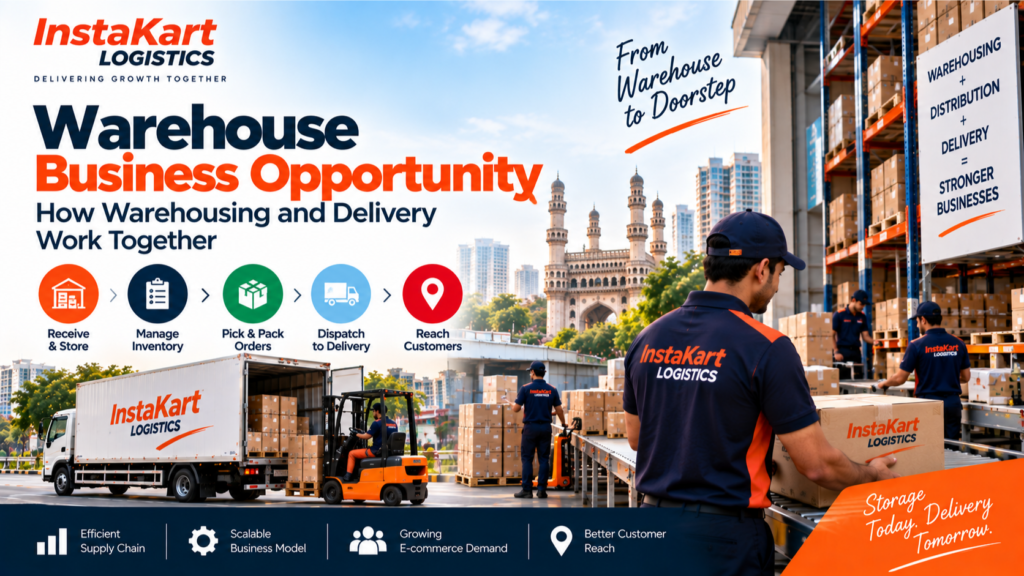
Warehouse Business Opportunity: How Warehousing and Delivery Work Together
When people think about logistics, they often imagine delivery vehicles travelling from one place to another. However, delivery is only one part of the larger supply chain.
Before a parcel reaches a customer’s doorstep, it may need to be received, stored, sorted, packed, scanned, and prepared for dispatch. This is where warehousing and delivery work together.
As e-commerce, retail, manufacturing, and direct-to-consumer businesses continue to expand, efficient warehousing has become increasingly important. For entrepreneurs, this creates an opportunity to explore a warehouse business opportunity that combines storage, distribution, and delivery services.
However, starting a warehouse business requires careful planning. Location, space, technology, staffing, transportation, customer demand, and operating costs all need to be considered.
Let’s understand how warehousing and delivery connect and why this combination can create opportunities for entrepreneurs.
What Is a Warehouse Business?
A warehouse business provides space and services for storing, managing, and moving goods.
Traditionally, warehouses were mainly used for storage. Today, their role has become much broader.
A modern warehouse may handle:
- Receiving goods
- Inventory management
- Product storage
- Sorting
- Picking and packing
- Shipment processing
- Dispatch
- Returns
- Distribution
In some business models, the warehouse also acts as a local distribution hub.
This means products don’t simply stay inside the facility. Instead, they move through the warehouse as part of a larger logistics network.
Why Are Warehousing and Delivery Connected?
Imagine an online business based in one city that sells products to customers across several areas.
The business needs somewhere to keep its inventory. It also needs a way to move each order to the customer.
This creates two connected requirements:
Warehousing = Where products are managed
Delivery = How products reach customers
When these functions work together, the process can become more organised.
A simplified supply chain looks like this:
Supplier → Warehouse → Order Processing → Sorting → Dispatch → Delivery Hub → Customer
The warehouse manages the inventory and prepares shipments, while the delivery network handles the movement of those shipments.
Therefore, efficient warehousing can directly support efficient delivery.
Why Is Warehousing Becoming an Opportunity for Entrepreneurs?
Several changes in the business environment are increasing the importance of warehouses.
Growth of E-Commerce
Online sellers need a place to store their products before orders are received.
As order volumes increase, managing inventory from a home, small office, or basic storage room can become difficult.
Consequently, e-commerce businesses may look for professional warehousing and fulfilment services.
Expansion of D2C Brands
Direct-to-consumer businesses are selling products directly through websites, social media, and online marketplaces.
These businesses may not want to invest heavily in their own warehouses.
Instead, they can work with third-party logistics providers that handle storage and fulfilment.
Wider Distribution Networks
Businesses are increasingly reaching customers outside their local markets.
As a result, products need to be positioned closer to different customer groups.
Regional and local warehouses can help support this distribution strategy.
Increasing Delivery Expectations
Customers have become accustomed to tracking shipments and receiving products at their doorstep.
Therefore, businesses need logistics operations that can process orders quickly and hand them over to delivery networks without unnecessary delays.
How Does a Warehouse and Delivery Business Work?
A warehouse and delivery operation can involve several stages.
1. Receiving
Products arrive at the warehouse from suppliers, manufacturers, or businesses.
The warehouse team receives and records the goods.
2. Storage
Products are placed in organised storage areas.
The layout should make it easy for employees to locate products when orders are received.
3. Inventory Management
The business keeps track of how many products are available.
Digital inventory systems can make this process easier and reduce manual errors.
4. Order Processing
When a customer places an order, the required product is identified.
The warehouse team then picks and prepares it.
5. Packing
The product is packed according to the requirements of the seller and shipment.
Proper packaging can help reduce damage during transportation.
6. Sorting
Parcels are organised according to destination, route, customer, or delivery service.
7. Dispatch
The prepared parcels leave the warehouse and enter the delivery network.
8. Last-Mile Delivery
Finally, the parcel reaches the customer’s location.
This is the stage where the warehouse operation connects directly with the delivery service.
Benefits of Combining Warehousing and Delivery
Combining these services can create operational advantages when managed properly.
Faster Order Processing
When inventory is already stored in a local warehouse, orders can be processed without waiting for products to travel from a distant location.
As a result, businesses may be able to prepare shipments more quickly.
Better Inventory Management
A structured warehouse provides a central location for managing products.
This can make it easier to monitor inventory levels and identify which products need replenishment.
Efficient Delivery Planning
When parcels are sorted before dispatch, delivery teams can organise routes more efficiently.
This can help reduce unnecessary movement.
Better Customer Experience
Faster processing and reliable delivery can contribute to a smoother customer experience.
Customers can also benefit from better shipment visibility when tracking systems are available.
Opportunity for Multiple Services
A warehouse business doesn’t necessarily have to earn revenue only from storage.
Depending on the business model, services may include:
- Storage
- Fulfilment
- Packing
- Parcel processing
- Distribution
- Last-mile delivery
- Returns management
This can provide multiple potential revenue streams.
What Is a Warehouse Franchise?
Entrepreneurs who don’t want to build a warehousing business entirely from scratch can explore a warehouse franchise.
Under a franchise model, an entrepreneur operates a warehouse or logistics business using an established brand and business framework.
Depending on the franchise company, support may include:
- Training
- Operational guidance
- Technology
- Branding
- Logistics systems
- Business support
However, the exact terms differ between companies.
Therefore, entrepreneurs should carefully review the investment requirements, territory, responsibilities, fees, revenue structure, support, and agreement terms before making a decision.
What Investment Is Required?
The investment required for a warehouse business depends on several factors.
There isn’t one fixed amount that applies to every business.
Important cost components can include:
Property
Rent, security deposit, utilities, maintenance, and basic improvements can form a significant part of the budget.
Warehouse Equipment
Depending on the operation, you may need:
- Storage racks
- Weighing equipment
- Packing tables
- Barcode scanners
- Computers
- Printers
- Material-handling equipment
Staff
Employees may be required for receiving, inventory management, packing, sorting, administration, and delivery operations.
Vehicles
If delivery is included in the business model, transportation costs should also be considered.
Technology
Inventory management, shipment tracking, order processing, and communication systems can all require investment.
Working Capital
Working capital is particularly important during the early stages.
A new business may need several months to build a stable customer base, so plan for recurring expenses rather than relying entirely on immediate revenue.
Choosing the Right Warehouse Location
Location can have a major effect on the success of a warehouse business.
A warehouse may have excellent facilities, but if delivery vehicles struggle to access it, operating costs can increase.
When evaluating a location, consider:
- Road connectivity
- Traffic conditions
- Distance from customers
- Nearby commercial areas
- Industrial activity
- Residential coverage
- Parking
- Loading and unloading space
- Availability of expansion space
For example, a warehouse closer to a major customer cluster may reduce delivery time compared with a cheaper facility located far away.
Therefore, don’t choose a property based solely on rent.
Think about the total logistics cost.
Who Can Explore a Warehouse Business Opportunity?
A warehouse business can be considered by entrepreneurs from different backgrounds.
You don’t necessarily need years of experience in logistics. However, you should be willing to learn the operational side of the business.
The opportunity may suit people with experience in:
- Business management
- Retail
- Transportation
- Sales
- Distribution
- Warehousing
- E-commerce
- Operations
Existing business owners may also consider the model if they have suitable commercial space or relationships with local businesses.
Most importantly, you should be prepared to manage employees, customers, inventory, costs, and daily operations.
How to Start a Warehouse and Delivery Business
If you’re considering this business opportunity, a structured approach can help.
Step 1: Study the Local Market
Start by identifying potential customers.
Look for:
- E-commerce sellers
- D2C brands
- Manufacturers
- Retailers
- Wholesalers
- Distributors
- Local businesses
Understand what these businesses need and whether they require storage, fulfilment, delivery, or a combination of services.
Step 2: Choose Your Business Model
Decide whether you want to focus on:
- Storage
- Fulfilment
- Distribution
- Last-mile delivery
- Warehouse franchise
- A combination of services
A clear business model will make it easier to plan your investment and operations.
Step 3: Calculate the Investment
Prepare a complete budget.
Include:
Property + Equipment + Staff + Technology + Vehicles + Marketing + Working Capital
Don’t forget recurring monthly expenses.
Step 4: Find a Suitable Location
Select a warehouse that supports efficient movement of products and vehicles.
Check accessibility before signing a long-term agreement.
Step 5: Organise the Warehouse
Create clearly defined areas for:
- Receiving
- Storage
- Picking
- Packing
- Sorting
- Dispatch
- Returns
A well-planned layout can reduce unnecessary movement and improve productivity.
Step 6: Set Up Technology
Use appropriate systems for inventory, shipments, orders, and reporting.
As the number of products and shipments increases, technology can become increasingly important.
Step 7: Build Your Delivery Network
If delivery is part of your model, establish a reliable process for moving parcels from the warehouse to customers.
This could involve your own delivery team, vehicles, or a logistics partner, depending on the business model.
Step 8: Acquire Customers
Approach businesses directly.
Explain how your warehouse and delivery services can help them save time, manage inventory, or reach customers more efficiently.
Building recurring business relationships should be a key objective.
The Role of Technology
Technology can connect warehousing and delivery into one coordinated system.
For example, when an order is received, the system can identify available inventory, create the required shipment information, and help move the parcel into the delivery process.
Useful technology can include:
Inventory Management
Helps track available stock.
Order Management
Helps process incoming orders.
Barcode Scanning
Can reduce manual entry and improve accuracy.
Shipment Tracking
Provides visibility into parcel movement.
Route Management
Can help delivery teams plan routes.
Digital Proof of Delivery
Provides a digital record of completed deliveries.
When these systems work together, the warehouse and delivery operation can become easier to manage.
Common Challenges to Consider
A warehouse business can offer opportunities, but it also comes with challenges.
Space Utilisation
Poorly organised inventory can waste valuable warehouse space.
Therefore, layout planning is important.
Inventory Accuracy
Incorrect stock records can lead to delayed orders and customer complaints.
Regular checks and digital systems can help.
Delivery Delays
Traffic, vehicle issues, weather, and other factors can affect deliveries.
A good operational plan should account for such situations.
Operating Costs
Rent, salaries, electricity, transportation, maintenance, and technology can all affect profitability.
Monitor these expenses regularly.
Customer Acquisition
A warehouse doesn’t automatically generate customers.
You need a clear sales strategy to build a reliable customer base.
How InstaKart Connects Warehousing and Delivery
For entrepreneurs exploring a warehouse business opportunity, InstaKart offers a logistics and warehouse franchise model that connects warehouse operations with parcel distribution and last-mile delivery.
The model is designed around moving parcels from local logistics hubs toward customers while supporting the operational side of warehousing and distribution.
This approach allows entrepreneurs to explore a business model that combines storage, parcel handling, distribution, and delivery rather than treating each activity as completely separate.
If you’re considering an InstaKart franchise, contact the company directly for the latest information about:
- Investment requirements
- Warehouse requirements
- Territory availability
- Operational responsibilities
- Technology
- Training
- Franchise support
- Revenue structure
- Agreement terms
Before investing, review the current franchise documentation carefully and evaluate the opportunity based on your own financial capacity and business plans.
Questions to Ask Before Starting
Before committing to a warehouse business, ask yourself and the franchise company some practical questions.
What type of customers will I serve?
Understanding your target customer is essential.
How much warehouse space do I need?
The answer depends on your expected inventory and shipment volume.
Will I provide delivery services?
Clarify whether delivery is part of your model or handled separately.
What technology will I use?
Ask about inventory, shipment tracking, and order management systems.
What are the monthly operating costs?
Consider rent, staff, utilities, vehicles, maintenance, and other expenses.
How will I acquire customers?
Prepare a local sales and marketing strategy before starting.
What support will the franchisor provide?
Get specific details about training, operations, technology, marketing, and ongoing support.
What are the franchise agreement terms?
Understand fees, territory, renewal, performance requirements, termination, and exit conditions.
Final Thoughts
A warehouse business opportunity is no longer limited to storing products in a large building.
Modern warehousing is closely connected with order fulfilment, distribution, inventory management, and last-mile delivery.
When these functions work together, businesses can move products from suppliers to customers more efficiently.
For entrepreneurs, this creates opportunities to build businesses around storage, fulfilment, distribution, delivery, or a combination of these services.
However, success requires more than warehouse space.
You need the right location, efficient processes, reliable employees, appropriate technology, strong customer relationships, and careful financial management.
So, before starting, take the time to understand your market and calculate the complete cost of running the operation.
Warehousing stores the product. Delivery moves it. Efficient logistics connects the two.
When that connection is managed well, a warehouse can become more than a storage facility—it can become an important part of a growing logistics business.