

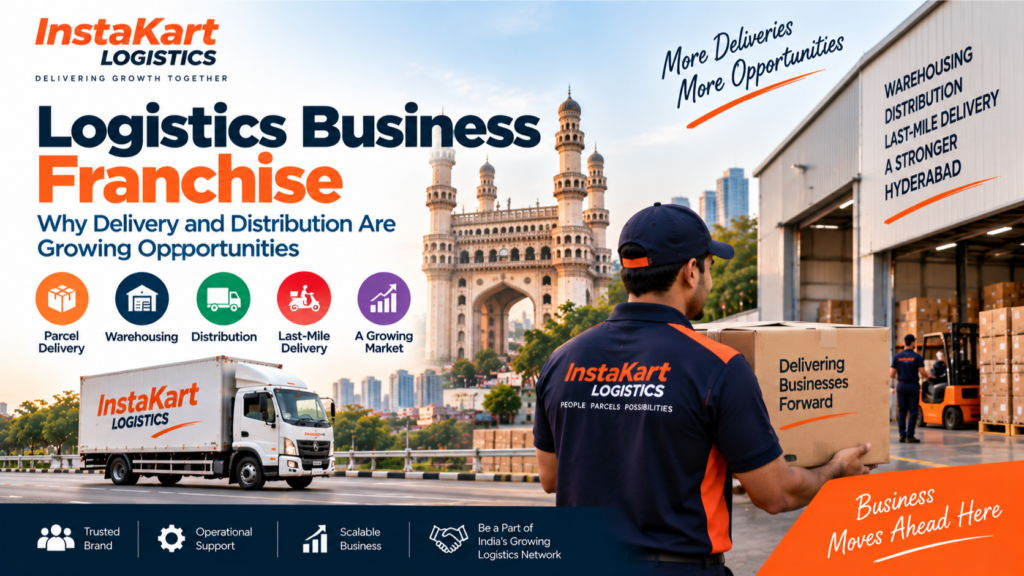
Logistics Business Franchise: Why Delivery and Distribution Are Growing Opportunities
The way businesses sell products has changed significantly over the past few years.
A customer can order something from a business in another city and receive it at their doorstep within a few days. Behind that simple experience, however, there is a complete logistics network handling pickup, transportation, warehousing, sorting, and delivery.
As businesses increasingly depend on these services, logistics has become more than just transportation. It has become an essential part of modern commerce.
For entrepreneurs, this creates an opportunity to explore a logistics business franchise. Instead of building a logistics company completely from scratch, entrepreneurs can work with an established business model and participate in delivery, distribution, warehousing, or related logistics services.
However, starting a franchise still requires careful planning. Investment, location, customer acquisition, operating costs, staff, technology, and franchise terms all need to be considered.
Let’s understand why delivery and distribution are creating opportunities and what entrepreneurs should know before entering the industry.
What Is a Logistics Business Franchise?
A logistics business franchise allows an entrepreneur to operate a logistics-related business under an established brand and business model.
Depending on the franchise, the business may focus on:
- Parcel delivery
- Last-mile delivery
- Warehousing
- Courier services
- Distribution
- Order fulfilment
- Local transportation
- Reverse logistics
The franchise company may provide support in areas such as branding, technology, training, operational processes, and business guidance.
However, the exact services and support vary from one company to another. Therefore, entrepreneurs should understand the specific franchise agreement before making an investment.
In a typical operation, goods may move through a process such as:
Business → Pickup → Sorting → Warehouse/Hub → Distribution → Last-Mile Delivery → Customer
The franchise partner can become an important part of this chain.
Why Is the Logistics Industry Growing?
There isn’t just one reason behind the growing importance of logistics.
Instead, several changes are happening at the same time.
E-Commerce Is Expanding
Online shopping has changed customer expectations.
People can order products from businesses located hundreds or even thousands of kilometres away. Consequently, sellers need dependable logistics partners to deliver those orders.
This is particularly important for small and medium-sized online businesses that may not have their own delivery network.
Businesses Are Reaching More Customers
A local business no longer has to depend entirely on customers who live nearby.
With websites, marketplaces, social media, and digital payments, businesses can sell to customers across cities and states.
However, wider customer reach also creates a logistics requirement.
The product has to reach the customer.
Therefore, as businesses expand their market, logistics often becomes an important part of their growth strategy.
Customers Expect Better Delivery Experiences
Customers today want more than just delivery.
They increasingly expect:
- Reliable delivery timelines
- Shipment tracking
- Delivery updates
- Convenient communication
- Safe parcel handling
- Simple return processes
As a result, businesses need logistics partners who can manage these expectations consistently.
Why Consider a Logistics Franchise?
Starting an independent logistics company can be rewarding, but it also requires building everything from the ground up.
You may need to develop your own brand, technology, processes, customer network, and operational systems.
A franchise can provide a more structured starting point.
1. Established Business Model
A franchise can give entrepreneurs a framework for operating the business.
Instead of trying to figure out every process independently, you may have established systems for handling shipments, customers, employees, and deliveries.
This can be especially useful for first-time entrepreneurs.
2. Brand Support
Building a new logistics brand takes time.
An established franchise can provide a recognised business identity, depending on the strength and reach of the brand.
However, local customer acquisition will still be important.
A strong brand may open the door, but reliable service helps maintain the relationship.
3. Technology and Tracking
Modern logistics depends heavily on technology.
Tracking systems can help businesses know where shipments are, while digital records can make it easier to manage daily operations.
Depending on the franchise, technology support may include:
- Shipment tracking
- Parcel scanning
- Delivery updates
- Route management
- Digital proof of delivery
- Reporting systems
Technology can therefore help reduce manual work and improve visibility.
4. Operational Guidance
Logistics involves many moving parts.
A franchise partner may receive guidance on areas such as parcel handling, delivery processes, staff management, customer service, and daily operations.
This structured approach can make the initial learning process easier.
Delivery and Distribution: What’s the Difference?
The terms “delivery” and “distribution” are sometimes used interchangeably, but they can represent different parts of the logistics process.
Delivery
Delivery usually refers to moving a shipment from a local facility or hub to the final customer or destination.
For example:
Local Hub → Customer
Distribution
Distribution can involve a broader movement of goods through a network.
For example:
Manufacturer → Distribution Centre → Wholesaler → Retailer
A logistics business can potentially operate in one area or combine several services depending on its model.
This creates flexibility for entrepreneurs who want to build their business around a particular customer segment.
Who Can Become a Logistics Franchise Partner?
A logistics franchise isn’t limited to people who already have years of experience in transportation.
Entrepreneurs from different backgrounds can explore the industry.
People with experience in:
- Business management
- Sales
- Retail
- Transportation
- Customer service
- Warehousing
- Operations
- Distribution
may already have skills that are useful in logistics.
Existing business owners can also consider the model if they have suitable space, employees, vehicles, or local business connections.
Most importantly, however, you should be comfortable managing an operating business.
Logistics isn’t usually a completely passive business.
Customers may need assistance, employees need supervision, shipments need monitoring, and operational problems need quick attention.
What Investment Is Required?
Investment is one of the first questions most entrepreneurs ask.
However, there isn’t one fixed investment amount for every logistics business franchise.
The actual requirement can depend on:
- Franchise model
- Location
- Office or warehouse size
- Equipment
- Staff
- Vehicles
- Technology
- Marketing
- Working capital
Therefore, don’t look only at the franchise fee.
Instead, calculate the complete cost of starting and operating the business.
Initial Costs
These may include franchise or onboarding fees, property deposits, equipment, technology, branding, and other setup expenses.
Monthly Costs
You may also need to budget for:
- Rent
- Salaries
- Fuel
- Vehicle maintenance
- Electricity
- Internet
- Technology
- Marketing
- Administrative expenses
Working Capital
Working capital deserves special attention.
A new franchise may take time to acquire enough customers and shipment volume to create stable cash flow.
Consequently, you should have enough funds to manage regular expenses during the early stages.
Why Location Matters in Logistics
Location can directly affect the efficiency of a logistics business.
A facility that is easy to access can make pickups, sorting, and deliveries more convenient.
When choosing a location, consider:
- Road connectivity
- Traffic conditions
- Nearby businesses
- Residential coverage
- Parking
- Loading and unloading space
- Distance from customers
- Availability of commercial properties
A cheaper property isn’t necessarily the most economical choice.
For instance, if delivery vehicles spend significantly more time travelling because of poor connectivity, transportation costs can increase.
Therefore, evaluate the location based on the total operating impact, rather than rent alone.
Building a Customer Base
A logistics franchise needs customers to generate regular shipment volume.
This means customer acquisition should be part of your business plan from the beginning.
Potential customers can include:
E-Commerce Sellers
Online sellers often require regular parcel pickup and delivery services.
Retail Businesses
Retailers may need local distribution and customer delivery.
Manufacturers
Manufacturers can require transportation between facilities, warehouses, distributors, and customers.
D2C Brands
Direct-to-consumer businesses depend heavily on reliable fulfilment and delivery.
Wholesalers and Distributors
These businesses may require regular movement of larger quantities of products.
Rather than depending on a single customer, building relationships across multiple customer segments can help create a more diversified business.
How Technology Can Improve Logistics Operations
Technology is now closely connected with logistics.
Imagine managing hundreds of parcels using only paper records. As shipment volume increases, it can become difficult to know where every parcel is and what needs to happen next.
Digital systems can simplify these processes.
Technology can help with:
- Shipment tracking
- Inventory management
- Route planning
- Parcel scanning
- Delivery status
- Customer notifications
- Digital proof of delivery
- Business reports
Moreover, data can help identify operational problems.
For example, if deliveries are regularly delayed in a particular area, the business can investigate whether the issue is related to traffic, route planning, staffing, or another factor.
As a result, technology can support better decision-making.
How to Build a Sustainable Logistics Franchise
Starting the franchise is only the beginning.
The real challenge is building a business that can operate consistently.
Focus on Service Quality
Customers want their parcels handled carefully and delivered as promised.
Therefore, service quality should remain a priority even as shipment volumes increase.
Build Long-Term Relationships
One-time shipments can generate revenue, but recurring business relationships can provide more predictable activity.
Focus on businesses that need logistics services regularly.
Control Operating Costs
Monitor fuel, salaries, rent, maintenance, and other expenses.
Small inefficiencies can become significant when shipment volumes increase.
Train Your Team
Delivery executives and warehouse employees represent your business every day.
Proper training can improve parcel handling, customer communication, and operational consistency.
Monitor Performance
Track important numbers such as:
- Daily shipment volume
- Delivery success rate
- Failed deliveries
- Revenue
- Operating expenses
- Customer complaints
- Repeat customers
- Staff productivity
Regular monitoring can help you identify problems before they become larger issues.
Common Mistakes New Franchise Owners Should Avoid
Choosing Only Based on Investment
A low entry cost doesn’t automatically mean the business model is suitable.
Look at the complete financial picture.
Expecting Guaranteed Profits
No business can guarantee the same financial outcome for every location and entrepreneur.
Instead, prepare realistic revenue and expense projections.
Ignoring Customer Acquisition
A franchise brand doesn’t mean customers will automatically arrive.
Local sales and relationship-building remain important.
Underestimating Working Capital
The business may take time to reach consistent shipment volumes.
Plan accordingly.
Not Reading the Franchise Agreement
Understand the territory, fees, responsibilities, renewal conditions, performance requirements, and exit clauses before signing.
Why Consider InstaKart for a Logistics Franchise?
For entrepreneurs exploring a logistics business franchise, InstaKart offers logistics and warehouse franchise models focused on parcel distribution and last-mile delivery.
The business model connects local logistics operations with warehouses, businesses, and customers. In addition, technology and structured operational processes can support shipment management and delivery activities.
For someone exploring the industry, the opportunity can be discussed directly with the company to understand the current:
- Investment requirements
- Franchise structure
- Territory availability
- Infrastructure requirements
- Technology
- Training
- Operational support
- Revenue model
- Agreement terms
Before making an investment, review the current franchise documentation carefully and consider your own financial capacity and business objectives.
Questions to Ask Before Investing
Before signing a franchise agreement, ask clear questions.
What is the total investment?
Ask for a complete breakdown rather than looking only at the franchise fee.
What territory will I receive?
Understand the exact area in which you can operate.
Is the territory exclusive?
Clarify whether another franchise of the same brand can operate in the same area.
How does the revenue model work?
Understand how you earn and what expenses or fees apply.
What support is included?
Ask about training, technology, marketing, operations, and customer support.
Are there performance requirements?
Check whether the agreement includes shipment, revenue, or other targets.
What are the renewal and exit terms?
Understand what happens when the agreement expires or if you decide to leave the franchise.
Is a Logistics Franchise Right for You?
A logistics franchise can be an option for entrepreneurs who want to enter the delivery and distribution industry with a structured business model.
However, it requires active management.
Before making a decision, consider:
- Your available investment
- Your local market
- Your business experience
- Your ability to manage employees
- Your customer acquisition strategy
- Your preferred level of involvement
- Your working capital
- The franchise agreement
If these factors align with your plans, the next step is to conduct detailed due diligence and speak directly with the franchise company.
Final Thoughts
The growth of e-commerce, online businesses, retail distribution, and direct-to-consumer brands has made logistics an essential part of modern business.
As a result, delivery and distribution are creating opportunities for entrepreneurs across India.
A logistics business franchise can provide a structured way to enter this industry. However, the franchise itself isn’t the entire business.
Success depends on what happens after you start.
You need to acquire customers, manage costs, train employees, maintain service quality, use technology effectively, and build long-term business relationships.
So, before investing, look beyond the headline opportunity.
Understand the numbers.
Study the market.
Check the territory.
Understand the support.
Read the agreement.
Plan for the long term.
When logistics operations are managed carefully, a local franchise can become more than a delivery business. It can become a dependable link between businesses and their customers—and potentially a foundation for building a larger logistics operation over time.