

10 Logistics Business Opportunities in Hyderabad for Aspiring Entrepreneurs
Hyderabad is known for its IT companies, growing residential communities, manufacturing activity, retail businesses, and expanding e-commerce market. Behind all these industries is another sector that keeps products and businesses moving: logistics.
A product sold online has to be picked up, sorted, transported, stored when necessary, and finally delivered to the customer. Similarly, manufacturers and retailers need reliable ways to move products between suppliers, warehouses, stores, and customers.
Because of this, logistics can offer several business opportunities for entrepreneurs in Hyderabad.
However, logistics is a broad industry. You don’t necessarily have to start a large transportation company or own a fleet of trucks. Depending on your budget, skills, location, and business goals, you can explore different models.
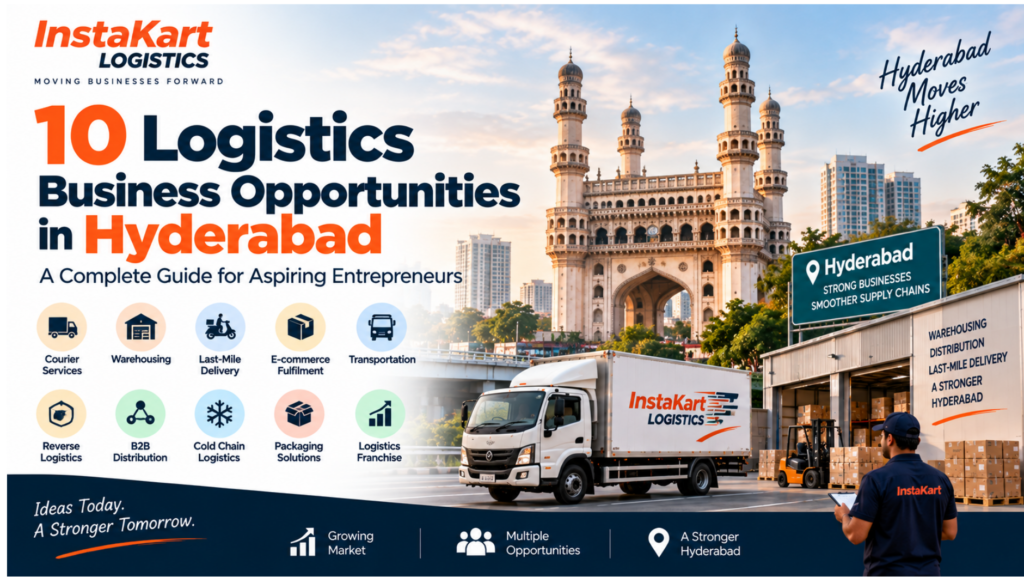
In this article, we’ll look at 10 logistics business opportunities in Hyderabad that aspiring entrepreneurs can consider.
Why Is Hyderabad Important for Logistics?
Hyderabad has a diverse economy, which creates demand for different types of logistics services.
The city has technology companies, pharmaceutical businesses, manufacturers, retailers, e-commerce sellers, wholesalers, restaurants, and numerous small businesses. As these businesses move products and materials, logistics becomes an essential part of their operations.
At the same time, customers have become accustomed to doorstep delivery and shipment tracking.
Therefore, businesses increasingly need logistics partners who can provide reliable transportation, warehousing, distribution, and last-mile delivery.
This combination of business activity and changing customer expectations creates several areas for entrepreneurs to explore.
1. Logistics Franchise
One of the options aspiring entrepreneurs can consider is a logistics franchise in Hyderabad.
A logistics franchise allows you to operate a local logistics business under an established brand and business model.
Instead of developing every process from the beginning, you may receive support related to operations, technology, branding, training, and logistics management, depending on the franchise company.
A typical model may connect:
Businesses → Pickup → Sorting → Local Hub → Delivery → Customer
Who can consider it?
This model may suit entrepreneurs who want to enter logistics but prefer to work within an established framework.
However, it is important to understand the franchise investment, territory, revenue structure, operating costs, and agreement terms before making a decision.
2. Warehouse Franchise
Warehousing is another area with potential in Hyderabad.
Online sellers, manufacturers, retailers, distributors, and other businesses may require space to store and manage their products before distribution.
A warehouse franchise in Hyderabad can combine storage with logistics and distribution.
Depending on the business model, the warehouse may handle:
- Receiving goods
- Storage
- Sorting
- Inventory management
- Packing
- Dispatch
- Parcel distribution
The warehouse can then connect with last-mile delivery operations.
Why is this interesting?
A warehouse doesn’t necessarily have to remain just a storage facility. It can become a local logistics hub that helps businesses move products closer to customers.
3. Last-Mile Delivery Business
Last-mile delivery is the final stage of the logistics journey.
For example, when a parcel reaches a local distribution hub, someone still needs to take it to the customer’s doorstep.
That final step is where last-mile delivery businesses operate.
An entrepreneur can potentially build a delivery operation serving:
- E-commerce businesses
- Retailers
- Local online sellers
- D2C brands
- Corporate customers
The business may operate with two-wheelers, commercial vehicles, or a combination of transportation options depending on the delivery requirements.
What makes it important?
Customers may judge an online shopping experience partly by the delivery experience. Consequently, reliable last-mile operations can be valuable to businesses.
4. Courier Franchise
A courier franchise can be another entry point into the logistics industry.
The business can focus on moving documents, parcels, products, and other shipments between businesses and customers.
A local courier operation may serve:
- Individuals
- Small businesses
- Retailers
- Online sellers
- Offices
- Manufacturers
However, competition can be significant.
Therefore, entrepreneurs should identify a clear target market and understand what makes their service useful to local customers.
For example, reliable pickup, good communication, convenient service, and strong local coverage can help differentiate a business.
5. E-Commerce Fulfilment Services
Running an online store involves much more than selling products.
Once an order is received, someone has to:
- Locate the product
- Pick it
- Pack it
- Prepare the shipment
- Dispatch it
- Track the delivery
- Handle returns
This entire process is known as order fulfilment.
An entrepreneur can build a business that provides fulfilment services for online sellers.
Instead of an e-commerce business maintaining its own warehouse and staff, it can outsource these activities to a fulfilment partner.
Potential customers include:
- Instagram sellers
- D2C brands
- Small e-commerce companies
- Shopify stores
- Marketplace sellers
- Growing local brands
As online businesses grow, outsourcing fulfilment can become increasingly useful.
6. Local Transportation Services
Not every logistics requirement involves parcels.
Businesses also need to move raw materials, inventory, equipment, and finished products between different locations.
This creates opportunities in local transportation.
Depending on your resources, you could explore services using:
- Mini trucks
- Light commercial vehicles
- Pickup vehicles
- Tempo-style vehicles
- Other commercial transportation
The key is to identify a specific market.
For example, you could serve retailers, manufacturers, wholesalers, construction businesses, or other companies that regularly need local transportation.
The advantage of a focused approach
Instead of trying to serve everyone, targeting one customer segment can make sales and operations easier to manage.
7. Reverse Logistics and Returns Management
Returns are an unavoidable part of e-commerce.
A customer may receive a product and decide to return it because of the size, colour, quality, damage, or simply a change of mind.
The product then needs to travel back through the logistics network.
This process is known as reverse logistics.
An entrepreneur can potentially build services around:
- Product pickups
- Return shipments
- Sorting
- Temporary storage
- Inspection
- Seller returns
- Exchange logistics
As online businesses become more organised, efficient return management can become an important operational requirement.
Why does it matter?
A poor return experience can frustrate customers and create additional costs for businesses.
Therefore, businesses have an incentive to manage returns efficiently.
8. B2B Distribution Services
Business-to-business logistics can provide another opportunity.
Instead of delivering individual parcels to consumers, B2B logistics focuses on moving products between businesses.
For example:
Manufacturer → Distributor → Retailer
or:
Wholesaler → Retail Store
These shipments may involve larger quantities and different delivery requirements.
Entrepreneurs can explore specialised distribution services for particular industries.
Potential sectors include:
- Retail
- FMCG
- Pharmaceuticals
- Electronics
- Industrial products
- Packaging materials
The exact requirements vary considerably by industry, so understanding the target sector is essential.
9. Cold Chain and Temperature-Controlled Logistics
Some products cannot simply be transported in a regular vehicle.
Food, pharmaceuticals, certain chemicals, and other temperature-sensitive products may require controlled transportation and storage.
This creates opportunities in cold chain logistics.
However, this is a more specialised business model and may require significant investment in:
- Refrigerated vehicles
- Temperature monitoring
- Specialised storage
- Backup systems
- Compliance procedures
- Trained staff
Therefore, it isn’t necessarily the simplest option for a first-time entrepreneur.
Nevertheless, entrepreneurs with relevant expertise and sufficient capital can explore this specialised segment.
10. Packaging and Logistics Support Services
Logistics starts before the parcel leaves the warehouse.
A product needs to be packaged properly before it can be transported.
This creates another business opportunity around packaging and logistics support.
You could provide:
- Corrugated boxes
- Courier bags
- Bubble wrap
- Protective packaging
- Labels
- Tapes
- Custom packaging
- Packing services
Online sellers and local businesses may need packaging materials regularly.
Moreover, you can combine packaging with fulfilment or courier services to create a broader offering.
How to Choose the Right Logistics Business
With so many possibilities, the biggest question is:
Which logistics business should you start?
There isn’t one answer for every entrepreneur.
Your choice should depend on your budget, skills, available infrastructure, target customers, and willingness to manage daily operations.
Consider Your Investment Capacity
Start by calculating how much capital you can realistically invest.
A small local delivery operation may have different requirements from a warehouse or cold-chain business.
Don’t forget working capital.
You may need funds for several months of salaries, rent, fuel, maintenance, technology, and other expenses before the business becomes stable.
Think About Your Existing Experience
Your previous experience can be useful.
For example, someone with sales experience may be comfortable building B2B relationships, while someone with transportation experience may understand fleet management better.
Similarly, an existing business owner may already have local contacts that can help with customer acquisition.
Study Your Local Market
Don’t assume that every logistics service has the same demand everywhere.
Research your target area.
Look for:
- E-commerce businesses
- Manufacturers
- Retailers
- Warehouses
- Distributors
- Online sellers
- Industrial areas
- Residential communities
Then identify what services businesses in that area actually need.
Understand the Competition
Hyderabad already has established logistics and courier companies.
Therefore, ask:
What will make customers choose my service?
Your answer could be:
- Better local coverage
- Faster pickup
- Specialised service
- Better customer support
- Technology
- Competitive pricing
- Industry-specific expertise
A clear value proposition can make customer acquisition easier.
How Technology Can Help a Logistics Business
Technology has become an important part of modern logistics.
Even a small operation can benefit from digital systems.
Technology can help with:
Shipment Tracking
Customers and businesses can see shipment status.
Route Management
Delivery routes can be planned more efficiently.
Inventory Management
Warehouses can track products digitally.
Digital Proof of Delivery
Delivery completion can be recorded electronically.
Customer Communication
Automated updates can keep customers informed.
Business Reporting
Owners can monitor shipments, revenue, delivery performance, and operating costs.
Technology doesn’t replace people. Instead, it helps people manage the operation more efficiently.
Common Mistakes New Logistics Entrepreneurs Should Avoid
Starting Without a Financial Plan
Don’t calculate only the initial investment.
Prepare a monthly expense forecast as well.
Choosing a Location Based Only on Rent
A cheaper location may create higher transportation costs if it is difficult to access.
Ignoring Customer Acquisition
A warehouse, vehicle, or franchise doesn’t automatically bring customers.
You need a plan for acquiring and retaining business.
Depending on One Customer
Having one large client may seem attractive, but relying heavily on one customer can create business risk.
Building a diversified customer base can provide greater stability.
Underestimating Operations
Logistics is an operational business.
Employees, vehicles, shipments, customers, and unexpected problems all require attention.
Making Unrealistic Profit Assumptions
Avoid basing your business plan on guaranteed returns.
Instead, calculate realistic revenue and expense scenarios.
Why Consider a Logistics Franchise in Hyderabad?
For entrepreneurs who want to enter the logistics industry with an established business model, a franchise can be one option to explore.
InstaKart offers logistics and warehouse franchise models focused on parcel distribution and last-mile delivery.
The model connects local logistics operations with warehouses, businesses, and customers, while technology and operational systems can help manage shipments and deliveries.
If you are considering an InstaKart franchise, discuss the latest information directly with the company regarding:
- Investment requirements
- Territory availability
- Infrastructure
- Operational responsibilities
- Technology
- Training
- Franchise support
- Revenue structure
- Agreement terms
Before making an investment, conduct your own financial analysis and review the franchise agreement carefully.
Final Thoughts
There are many logistics business opportunities in Hyderabad, and you don’t necessarily need to build a massive transportation company to enter the industry.
A logistics franchise, warehouse franchise, last-mile delivery business, courier service, fulfilment centre, local transportation company, reverse logistics service, B2B distribution operation, cold-chain business, or packaging service can each serve different parts of the supply chain.
The right opportunity depends on your resources and business goals.
So, before choosing a business model, start with the basics.
Understand the market.
Calculate the costs.
Study the competition.
Identify your customers.
Choose the right location.
Build efficient operations.
Most importantly, focus on solving a real logistics problem for businesses and customers.
The logistics industry may look like it is simply about moving goods from one place to another. In reality, it is about connecting businesses with people efficiently and reliably.
For an entrepreneur willing to learn the industry and manage operations carefully, that connection can become the foundation for a long-term business.