
Logistics Franchise in Hyderabad: Documents and Requirements
Starting a logistics business can be an attractive opportunity for entrepreneurs who want to enter the growing delivery and distribution sector. Hyderabad, in particular, has a strong mix of e-commerce businesses, retailers, manufacturers, warehouses, distributors, and service companies that depend on regular movement of goods.
However, choosing a logistics franchise in Hyderabad is not only about selecting a location and making an investment. Before starting operations, you need to understand the documents, infrastructure, staffing, financial requirements, and operational responsibilities involved.
The exact requirements can differ depending on the franchise company, business structure, services offered, and size of the operation. Therefore, it is always important to confirm the latest requirements with the franchisor and relevant authorities.
Here is a practical guide to help you understand what you may need.
What Is a Logistics Franchise?
A logistics franchise allows an entrepreneur to operate a logistics or delivery business under an established brand and business system.
Instead of developing everything independently, a franchise partner may receive support related to:
- Brand and business identity
- Operating procedures
- Technology systems
- Training
- Logistics processes
- Customer acquisition
- Marketing
- Shipment management
- Delivery operations
Depending on the model, the franchise may provide services such as parcel delivery, last-mile delivery, warehousing, pickup, fulfilment, and business-to-business logistics.
As a result, the documents and infrastructure required can vary according to the services you plan to provide.
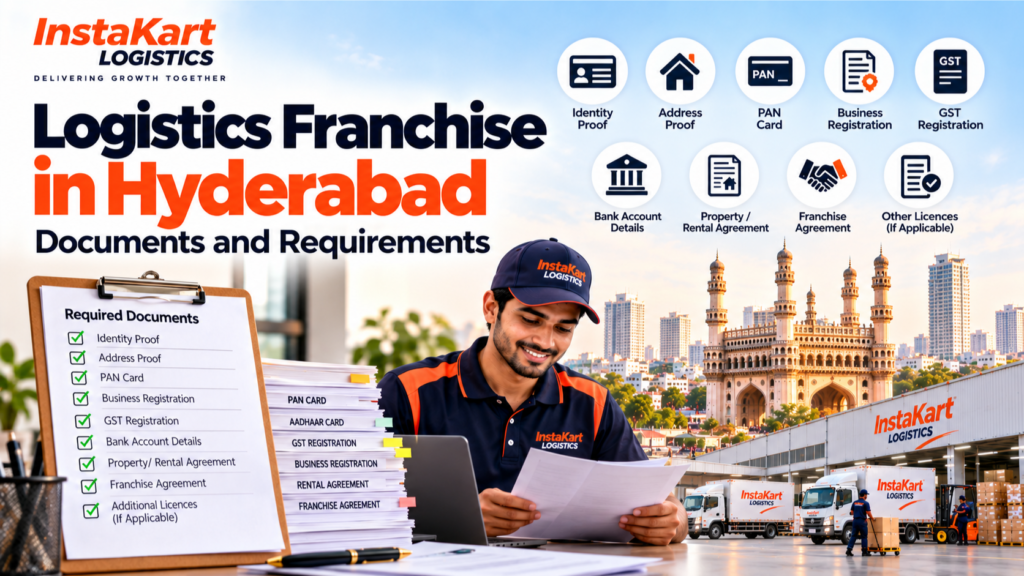
Documents Required for a Logistics Franchise in Hyderabad
Before beginning the franchise process, you will generally need a set of personal, business, financial, and property-related documents.
1. Identity Proof
The franchise applicant will generally need valid identity documents.
Commonly accepted documents may include:
- PAN Card
- Aadhaar Card
- Passport
- Voter ID
- Driving Licence
The exact documents required can depend on the franchisor and the legal structure of the business.
2. Address Proof
Proof of residential or business address may also be required.
Examples include:
- Aadhaar
- Passport
- Electricity bill
- Telephone bill
- Bank statement
- Rental agreement
- Property documents
Keeping current and matching address information across your documents can make the verification process easier.
3. PAN Card
A PAN is important for financial and tax-related activities.
If the franchise is being operated through a company, partnership, LLP, or another business entity, the relevant entity’s PAN may also be required.
Therefore, it is useful to decide your business structure before completing the formal documentation.
4. Business Registration Documents
If you are operating the franchise through an existing business, the franchisor may ask for its registration documents.
Depending on the structure, these could include:
- Proprietorship documents
- Partnership deed
- LLP incorporation documents
- Private Limited Company incorporation documents
- Memorandum and Articles of Association, where applicable
- Business PAN
- Other applicable registration certificates
Not every franchise requires a company or LLP. A suitable structure should be selected based on your business plans and professional advice.
5. GST Registration
GST requirements depend on the nature and scale of the business and applicable tax rules.
A logistics business may need GST registration depending on its taxable supplies, turnover, business model, and other applicable conditions.
If GST registration applies to your business, you may need documents such as:
- PAN
- Aadhaar
- Business address proof
- Bank account details
- Business registration documents
- Photographs
- Other applicable information
Because tax requirements can change and depend on individual circumstances, it is advisable to verify the current requirements with a qualified tax professional or the relevant government authority.
6. Bank Account Details
A dedicated business bank account is generally useful for managing franchise-related transactions.
It can help you separate:
- Customer payments
- Business expenses
- Employee payments
- Vendor payments
- Franchise-related payments
- Tax-related transactions
The franchisor may request cancelled cheque or bank account details during onboarding.
7. Address or Property Documents
If you have already selected your franchise location, the company may ask for proof that you have the right to use the premises.
Depending on the situation, this could include:
- Rental agreement
- Lease agreement
- Ownership documents
- Property tax documents
- Utility bill
- Landlord NOC, where applicable
For a rented location, make sure the agreement clearly permits the intended commercial activity.
8. Franchise Agreement
One of the most important documents is the franchise agreement.
This document establishes the relationship between the franchisor and franchise partner.
Before signing, carefully review points such as:
- Franchise fees
- Territory
- Agreement duration
- Renewal terms
- Royalty or revenue-sharing arrangements
- Branding requirements
- Operational responsibilities
- Technology charges
- Marketing obligations
- Termination conditions
- Exclusivity, if any
- Performance requirements
Do not rely only on verbal promises. Important commercial terms should be clearly mentioned in the written agreement.
For significant investments, getting the agreement reviewed by a qualified legal professional can also be a sensible step.
9. Photographs and KYC Documents
Franchise onboarding may also require basic KYC information from the business owner or authorised representatives.
This can include:
- Passport-size photographs
- PAN
- Aadhaar or other identity proof
- Address proof
- Contact information
- Signature specimens
These documents are generally used for verification and business onboarding.
Infrastructure Requirements for a Logistics Franchise
Documents are only one part of starting a logistics franchise. You also need suitable infrastructure to operate efficiently.
Office Space
A basic office may be required for:
- Customer communication
- Shipment booking
- Administration
- Staff operations
- Documentation
- Business development
The required size depends on the franchise model and shipment volume.
Storage or Warehouse Space
If your franchise includes warehousing, you may need additional space for:
- Parcel storage
- Inventory
- Sorting
- Packing
- Dispatch
- Returns
The warehouse should ideally allow easy movement of people, parcels, and vehicles.
Computers and Internet
Technology is an important part of modern logistics operations.
Basic requirements may include:
- Desktop or laptop computers
- Reliable internet
- Printer
- Scanner
- Barcode scanner, where required
- Weighing machine
- CCTV
- Power backup
The franchisor may also specify particular software or hardware requirements.
Vehicle and Delivery Requirements
Depending on the franchise model, transportation requirements may include:
- Two-wheelers
- Three-wheelers
- Mini trucks
- Commercial vehicles
- Delivery vans
Some franchise models may allow the partner to work with third-party delivery personnel or transport partners instead of owning an entire fleet.
Therefore, clarify who is responsible for vehicles, fuel, maintenance, insurance, and driver-related expenses before signing the agreement.
Staff Requirements
The number of employees required depends largely on shipment volume and the services you provide.
A small operation might initially need:
- Branch or operations manager
- Delivery executives
- Pickup executives
- Warehouse staff
- Customer support
- Business development staff
As shipment volume increases, the team can be expanded accordingly.
However, hiring too many employees before establishing sufficient business volume can increase operating costs. Therefore, staffing should ideally grow alongside demand.
Technology Requirements
A modern logistics franchise needs more than vehicles and delivery personnel.
Technology can help manage:
- Shipment booking
- Parcel tracking
- Pickup schedules
- Delivery status
- Customer information
- Inventory
- Returns
- Reports
- Payments
A good technology system can also reduce manual errors and provide better visibility into daily operations.
Financial Requirements
Before starting a logistics franchise in Hyderabad, prepare a realistic budget.
Your initial and ongoing expenses may include:
Initial Expenses
- Franchise fee, if applicable
- Office setup
- Warehouse setup
- Computers and equipment
- Security systems
- Branding
- Furniture
- Initial marketing
- Vehicle-related expenses
- Registration and professional fees
Monthly Expenses
- Office or warehouse rent
- Employee salaries
- Fuel
- Vehicle maintenance
- Electricity
- Internet
- Packaging materials
- Software or technology charges
- Marketing
- Insurance
- Other administrative expenses
The exact investment varies considerably from one franchise model to another. Therefore, avoid making a decision based only on a headline investment figure.
Licences and Registrations
The registrations required can depend on your business structure, premises, employees, vehicles, and services.
Depending on the circumstances, you may need to evaluate requirements related to:
- GST
- Shop and Establishment registration
- Local municipal permissions
- Trade-related licences
- Business registration
- Professional tax, where applicable
- Employee-related registrations
- Vehicle and transport compliance
- Fire and safety requirements for applicable premises
Not every logistics franchise will require every registration listed above.
Therefore, verify the requirements applicable to your specific business before beginning operations.
How to Choose the Right Location in Hyderabad
Location can have a major impact on logistics operations.
When evaluating a location, consider:
- Accessibility to major roads
- Proximity to customers
- Nearby warehouses
- Industrial areas
- E-commerce businesses
- Retail markets
- Availability of delivery staff
- Vehicle accessibility
- Rental costs
- Scope for expansion
Areas around major logistics and industrial corridors may offer opportunities, but the best location ultimately depends on your target customers and delivery territory.
A slightly higher-rent location may sometimes make sense if it significantly improves operational efficiency. On the other hand, low rent alone does not necessarily make a location profitable.
Important Questions to Ask Before Taking a Franchise
Before signing a franchise agreement, ask the franchisor clear questions.
About Investment
- What is the total initial investment?
- Is there a franchise fee?
- Are there recurring fees?
- What working capital is recommended?
About Operations
- What services will I be responsible for?
- Who manages delivery personnel?
- Who provides technology?
- Who handles customer complaints?
- How are returns managed?
About Territory
- What geographical area will I operate in?
- Is the territory exclusive?
- Can another franchise operate nearby?
About Revenue
- How is revenue calculated?
- Is there a fixed commission or revenue-sharing model?
- What are the charges for different services?
- Are there minimum shipment requirements?
About Support
- Is training provided?
- Is marketing support provided?
- Is technology support included?
- Who helps with initial setup?
Getting clear answers to these questions can help you compare franchise opportunities more objectively.
Common Mistakes to Avoid
Starting a logistics franchise can become challenging if the planning stage is rushed.
Choosing a Location Only Because Rent Is Low
Low rent may look attractive, but poor accessibility can increase delivery time and transportation costs.
Ignoring Working Capital
Do not calculate only the setup investment. You should also plan for several months of operating expenses.
Depending on One Customer
Building a customer base across multiple businesses can reduce the risk associated with depending heavily on a single account.
Not Reading the Franchise Agreement
Understand the commercial and operational terms before signing.
Underestimating Staffing
Insufficient staff can affect pickup and delivery performance, especially as shipment volume increases.
Expecting Guaranteed Profits
No genuine business model can guarantee a particular level of profit. Revenue and profitability depend on actual business performance and operating costs.
Why Consider InstaKart for a Logistics Franchise?
InstaKart Logistics provides a logistics franchise model focused on delivery and distribution operations.
For entrepreneurs exploring the logistics sector, the opportunity can be evaluated based on factors such as the business model, territory, infrastructure requirements, technology, operational support, and customer acquisition approach.
Before investing, prospective franchise partners should confirm the latest franchise fees, documentation, territory terms, infrastructure requirements, support structure, and commercial conditions directly with InstaKart.
You can learn more about the business and franchise model at www.instakartlogistics.com.
Final Checklist for Starting a Logistics Franchise
Before launching your franchise, make sure you have reviewed the following:
- Identity and address documents
- PAN and applicable KYC documents
- Business registration documents
- GST requirements
- Business bank account
- Premises or rental documents
- Franchise agreement
- Office setup
- Warehouse requirements, if applicable
- Delivery and transportation arrangements
- Staff requirements
- Technology and tracking systems
- Initial investment
- Working capital
- Applicable licences and registrations
- Insurance and vehicle compliance
- Customer acquisition plan
Conclusion
Starting a logistics franchise in Hyderabad requires more preparation than simply arranging an office and delivery vehicles. The right documents, location, infrastructure, employees, technology, working capital, and operational plan all contribute to building a sustainable business.
The good news is that you do not necessarily have to build every part of the logistics operation from scratch when you choose a suitable franchise model. An established system can provide a framework, while the franchise partner focuses on local operations, customer acquisition, and business growth.
Before making the investment, however, take time to understand the franchise agreement, costs, responsibilities, territory, revenue structure, and ongoing support. A well-researched decision can help you enter the logistics industry with clearer expectations and a stronger business plan.