

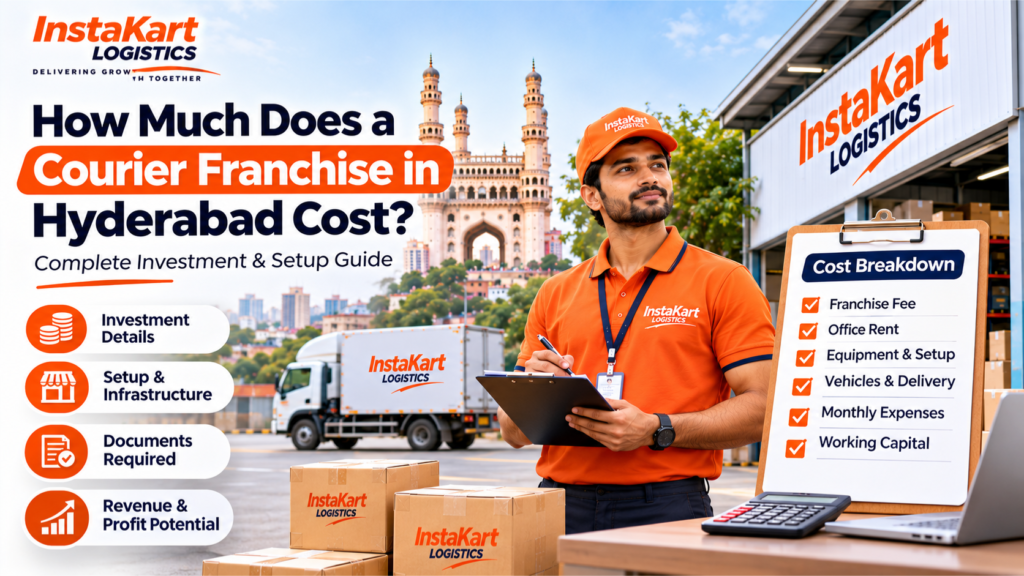
How Much Does a Courier Franchise in Hyderabad Cost?
Starting a courier franchise can be an attractive business opportunity for entrepreneurs who want to enter the logistics and delivery industry. With the growth of online shopping, local businesses, and e-commerce sellers, the need for reliable parcel delivery services continues to create opportunities for new businesses.
Hyderabad is a city worth exploring for this opportunity. It has a growing business ecosystem, residential communities, retail markets, industrial areas, and online sellers who regularly depend on courier services.
However, one important question comes before starting: How much does a courier franchise in Hyderabad cost?
The investment depends on the franchise company, office location, business model, infrastructure, staffing, and services you plan to offer. A small courier booking centre may require a relatively modest budget, while a larger branch handling pickups, sorting, and local deliveries will need additional investment.
In this guide, we will break down the possible costs, monthly expenses, business requirements, and factors that influence the investment.
1. What Is the Average Cost of a Courier Franchise in Hyderabad?
There is no fixed investment amount for every courier franchise. Different companies offer different packages depending on their brand, services, operational support, and franchise requirements.
For initial financial planning, you can consider these illustrative investment ranges:
| Courier franchise model | Indicative initial investment |
|---|---|
| Small courier booking centre | ₹1 lakh–₹3 lakh |
| Standard courier franchise outlet | ₹3 lakh–₹6 lakh |
| Courier hub with pickup and delivery | ₹5 lakh–₹10 lakh or more |
| Larger courier and distribution centre | ₹10 lakh onwards |
These are general budgeting estimates, not official quotations from any specific franchise company. Actual investment may be lower or higher depending on the location, franchise fees, equipment, property costs, and operational requirements.
Some companies may include software, branding, or training in their packages, while others may charge separately.
Therefore, always request a complete written quotation before making a payment.
2. Breakdown of Initial Investment
To understand how much money you need, it is useful to divide the investment into different categories.
A. Franchise or Registration Fee
Some courier companies charge an initial franchise or onboarding fee to allow you to operate under their brand and business model.
Depending on the company, this fee may cover:
- Brand usage.
- Franchise onboarding.
- Initial training.
- Software access.
- Operational guidance.
- Marketing materials.
- Territory allocation.
However, not every company includes all these services in its franchise fee.
Before paying, ask whether there are additional charges for renewal, security deposits, software, or ongoing support.
B. Office Rent and Security Deposit
A courier franchise needs a suitable commercial space for parcel booking, customer enquiries, documentation, and shipment handling.
Your property-related expenses may include:
- Monthly office rent.
- Security deposit.
- Electricity connection.
- Internet installation.
- Furniture.
- Signage and branding.
The rental cost depends on the area, property size, accessibility, and nearby commercial activity.
You do not necessarily need a large office to start. A small, accessible space may be sufficient for a basic courier booking centre.
C. Furniture and Equipment
Your branch will need basic equipment to manage daily courier operations.
Common requirements include:
- Desktop computer or laptop.
- Printer.
- Digital weighing machine.
- Barcode scanner, if required.
- Office tables and chairs.
- Parcel storage racks.
- CCTV cameras.
- Internet connection.
- Packaging materials.
The exact equipment depends on the franchise company’s operating system.
Avoid purchasing expensive equipment before confirming the franchisor’s specifications.
D. Vehicle and Transportation Expenses
If your franchise includes parcel pickup and delivery, transportation can become a significant part of your investment.
Possible expenses include:
- Two-wheelers or delivery vehicles.
- Fuel.
- Vehicle insurance.
- Maintenance.
- Delivery bags.
- Employee travel expenses.
Some courier franchise models may use an existing transportation network or third-party delivery partners. In such cases, you may not need to purchase vehicles immediately.
Clarify who is responsible for pickup, transportation, and last-mile delivery before signing the agreement.
3. Monthly Operating Expenses
Apart from the initial investment, you need enough money to operate the business every month.
Here are the common expenses to consider:
| Expense | What it covers |
|---|---|
| Office rent | Commercial property rental |
| Salaries | Booking staff and delivery executives |
| Fuel | Pickup and delivery transportation |
| Electricity | Office and equipment usage |
| Internet | Tracking and communication |
| Packaging | Boxes, tape, labels, and supplies |
| Maintenance | Equipment and vehicle repairs |
| Marketing | Local promotions and customer acquisition |
| Administration | Accounting and other business expenses |
Your monthly expenses will depend on the size of your branch, employee strength, shipment volume, and operational responsibilities.
For example, a small booking centre may have limited staffing expenses, while a delivery hub will require additional resources.
It is important to prepare a monthly budget before opening the branch.
4. How Much Space Is Required for a Courier Franchise?
The space requirement depends on the type of courier operation.
A basic courier booking centre may need enough room for:
- Customer reception.
- Parcel weighing and booking.
- Temporary parcel storage.
- Packing and documentation.
- Staff operations.
A larger branch that handles pickups, sorting, and local delivery may require additional storage and loading space.
Before renting a property, check the franchisor’s space requirements.
Also, evaluate road connectivity, vehicle access, parking, security, and the availability of delivery personnel in the area.
5. Which Areas in Hyderabad Are Suitable for a Courier Franchise?
Choosing the right location can influence customer acquisition and operating expenses.
Depending on your target customers, you can evaluate the following areas:
Kukatpally
Kukatpally has residential communities, retail businesses, and commercial establishments. It may be worth considering for a courier branch targeting local customers and online sellers.
Miyapur
Miyapur can be evaluated for businesses serving residential communities, local retailers, and nearby commercial areas.
Kompally
Kompally may suit entrepreneurs looking to serve northern Hyderabad and surrounding locations.
Medchal
Medchal is worth evaluating for courier and logistics businesses targeting industrial, warehouse, and distribution-related customers.
Jeedimetla
Jeedimetla may be relevant for businesses serving industrial units, wholesalers, and commercial customers.
Patancheru
Patancheru can be considered for courier operations targeting manufacturers, distributors, and business-to-business shipments.
Gachibowli and Madhapur
These areas may provide opportunities to serve offices, startups, commercial establishments, and online businesses.
Shamshabad
Shamshabad may suit businesses looking to serve southern Hyderabad and nearby commercial areas.
However, the best location depends on your franchise territory, customer demand, local competition, rent, and transportation access.
Do not finalise a property before checking whether the franchisor approves the location.
6. What Documents Are Required to Start a Courier Franchise?
The documents required depend on the company and your business structure.
Commonly requested documents may include:
- PAN card.
- Aadhaar card or other identity proof.
- Address proof.
- Passport-size photographs.
- Business registration documents, where applicable.
- Bank account details.
- Rental agreement or property documents.
- GST registration, where applicable.
- Signed franchise agreement.
Depending on the nature of your operations, additional local permissions or registrations may apply.
Ask the franchisor for a complete onboarding checklist and consult a qualified professional to understand the legal and tax requirements applicable to your business.
7. How Does a Courier Franchise Generate Revenue?
A courier franchise can generate revenue through different shipment and logistics services, depending on the agreement.
Parcel Booking
Customers visit your branch to send documents, packages, and products to other locations. The franchise may receive an agreed commission or share of the shipment charges.
Business-to-Business Shipments
Local businesses regularly send products, samples, documents, and commercial parcels.
Developing relationships with businesses that ship frequently can help build a consistent customer base.
E-commerce Shipments
Online sellers need courier services to deliver products to customers.
You can approach local clothing stores, jewellery businesses, electronics retailers, cosmetics sellers, and other online businesses.
Pickup Services
Some courier models allow franchise partners to collect parcels directly from customers or business locations.
This can be useful for customers who prefer doorstep pickup.
Last-Mile Delivery
Depending on the franchise model, you may also earn through local parcel delivery and distribution services.
Return Shipments
E-commerce returns and exchange shipments can provide additional business opportunities when reverse logistics is included in the service offering.
Remember that revenue is not the same as profit. Your final earnings depend on the agreed commission, shipment volume, operating expenses, and payment terms.
8. How to Calculate Your Break-Even Point
Before investing, estimate how much business you need to cover your monthly expenses.
For example, suppose your monthly operating expenses are ₹40,000 and your average contribution after shipment-related variable costs is ₹20 per parcel.
You would need approximately 2,000 parcels per month to cover those expenses.
This is only a simplified illustration. Your actual calculation should include different shipment categories, commission rates, fixed costs, variable expenses, and any revenue-sharing arrangements.
A realistic break-even calculation helps you understand whether your target shipment volume is achievable.
9. How to Reduce Your Initial Investment
If you have a limited budget, you can take a few practical steps to control your startup expenses.
- Start with a suitable office: Avoid renting a larger space than your business requires.
- Buy essential equipment: Purchase additional equipment only when operational demand increases.
- Use transportation arrangements carefully: Check whether the franchise offers an existing delivery network before purchasing vehicles.
- Hire according to demand: Begin with the staff required for your expected shipment volume.
- Compare franchise packages: Evaluate what each company includes in its fee.
- Promote locally: Focus on nearby businesses and online sellers before spending heavily on advertising.
- Maintain working capital: Do not spend your entire budget on the initial setup.
Reducing unnecessary expenses is useful, but never compromise on essential security, safety, or operational requirements.
10. Common Mistakes to Avoid When Investing
New entrepreneurs sometimes make avoidable mistakes while selecting a courier franchise.
Choosing Only Based on Low Franchise Fees
A low entry fee does not necessarily mean lower overall investment. Always calculate the complete setup and operating costs.
Ignoring Monthly Expenses
Rent, salaries, fuel, and maintenance can affect your finances even when shipment volumes are low.
Selecting the Wrong Location
A location with limited customer demand may make it difficult to develop regular business.
Expecting Guaranteed Profits
No genuine business opportunity can guarantee a particular level of earnings. Performance depends on customer acquisition, shipment volume, expenses, and management.
Not Reading the Agreement
Understand the commission structure, territory, recurring fees, responsibilities, and termination conditions before signing.
Depending Only on Walk-In Customers
Build relationships with local businesses and online sellers who may require regular courier services.
11. Questions to Ask Before Paying the Franchise Fee
Before making an investment, ask the courier company:
- What is the complete franchise investment?
- Are there any recurring fees?
- What services are included?
- How is the commission calculated?
- What territory will I receive?
- Is the territory exclusive?
- Who manages transportation and delivery?
- Is software and tracking included?
- What training is provided?
- Are marketing and operational support available?
- What are the renewal and termination conditions?
- Is there any minimum shipment requirement?
Request written answers and carefully review the agreement before paying.
Why Consider InstaKart Logistics?
If you are exploring a courier franchise in Hyderabad, you can also learn more about InstaKart Logistics.
InstaKart focuses on logistics, parcel distribution, and delivery-related services. Entrepreneurs can evaluate its franchise business model based on their investment capacity, preferred location, and business objectives.
Before proceeding, contact the company directly to confirm:
- Current franchise investment.
- Available locations and territories.
- Eligibility requirements.
- Infrastructure requirements.
- Revenue and commission structure.
- Technology and training support.
- Operational responsibilities.
- Franchise agreement terms.
Ask for a detailed written quotation so you can understand the complete cost before making a commitment.
Final Checklist Before Starting a Courier Franchise
Before launching your branch, make sure you have:
- Selected a suitable courier franchise company.
- Calculated the complete initial investment.
- Prepared a monthly operating budget.
- Arranged sufficient working capital.
- Finalised an accessible office location.
- Checked the required documents.
- Understood the commission structure.
- Reviewed the franchise agreement.
- Arranged essential equipment.
- Planned staffing and transportation.
- Understood the shipment tracking system.
- Prepared a customer acquisition strategy.
Conclusion
The cost of starting a courier franchise in Hyderabad depends on the business model, franchise fees, office location, equipment, staffing, transportation, and working capital.
A small courier booking centre may require a relatively modest investment, while a larger operation handling pickups, sorting, and deliveries will need additional resources.
Before investing, compare franchise opportunities, calculate your total expenses, understand the revenue model, and research customer demand in your preferred area.
Most importantly, choose a franchise that matches your financial capacity and ability to manage daily operations. With realistic planning, consistent customer acquisition, and disciplined cost management, you can build a stronger foundation for entering Hyderabad’s courier and logistics industry.