
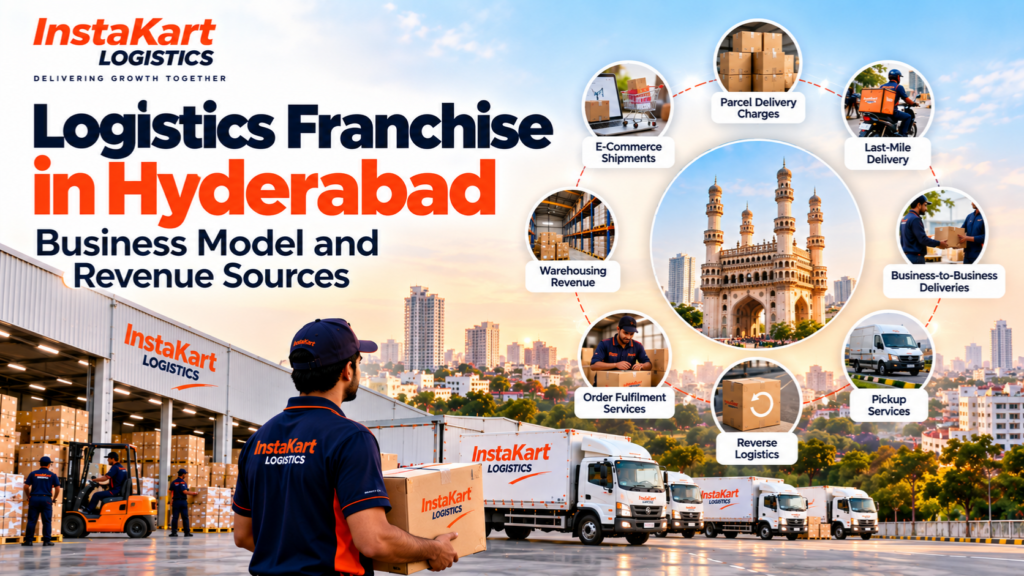
Logistics Franchise in Hyderabad: Business Model and Revenue Sources
Hyderabad has become an important business and distribution hub for companies across Telangana and other parts of India. With the growth of e-commerce, online businesses, retail distribution, D2C brands, and local businesses, the need for reliable logistics services continues to increase.
For entrepreneurs, this creates an interesting opportunity: starting a logistics franchise in Hyderabad.
However, before investing in a franchise, it is important to understand how the business actually works. A logistics franchise is not simply about delivering parcels. It can involve pickup, transportation, sorting, warehousing, last-mile delivery, customer support, and technology-enabled tracking.
More importantly, a franchise owner can potentially generate revenue through multiple logistics activities rather than depending on just one service.
This guide explains the business model, major revenue sources, operating requirements, costs, and important factors to consider before starting a logistics franchise in Hyderabad.
What Is a Logistics Franchise?
A logistics franchise is a business model where an entrepreneur operates a logistics service under an established brand.
Instead of building a logistics company completely from scratch, the franchise partner generally receives access to an existing brand, business model, operational processes, technology, and support system.
Depending on the franchise model, the franchise owner may handle activities such as:
- Parcel pickup
- Parcel booking
- Local delivery
- Last-mile delivery
- Shipment coordination
- Warehousing
- Order fulfilment
- Business-to-business deliveries
- E-commerce shipments
- Reverse logistics
- Customer support
- Shipment tracking
Therefore, the exact responsibilities and revenue structure can vary from one logistics franchise to another.
How Does a Logistics Franchise in Hyderabad Work?
The basic business model is relatively straightforward.
A customer or business needs to move goods from one location to another. The franchise acts as a local operational point that helps coordinate the movement of those goods.
A typical process may look like this:
Customer / Business → Pickup → Sorting → Transportation → Local Hub → Last-Mile Delivery → Customer
For example, imagine a Hyderabad-based online clothing store receiving 100 orders from customers in different areas.
The logistics franchise may collect the parcels from the seller, process the shipments, coordinate transportation, and ensure that the parcels reach the respective customers.
In addition, the franchise may handle return shipments when customers request replacements or refunds.
As a result, logistics franchises can become an important link between businesses and their customers.
Understanding the Logistics Franchise Business Model
The business model usually has three major components:
1. Customer Acquisition
The franchise needs to bring businesses and customers into the logistics network.
These could include:
- E-commerce sellers
- Local retailers
- Manufacturers
- Wholesalers
- D2C brands
- Online sellers
- Pharmaceutical businesses
- Electronics businesses
- Small and medium enterprises
Building a strong local customer base is important because regular shipment volume can provide more predictable business than relying only on individual customers.
2. Logistics Operations
Once customers start using the service, the franchise manages the operational side.
This can include:
- Pickup scheduling
- Shipment processing
- Parcel sorting
- Dispatch coordination
- Delivery management
- Tracking updates
- Return handling
- Customer communication
Efficient operations are particularly important because delays can affect both customer satisfaction and business relationships.
3. Revenue Generation
The franchise earns money through the logistics services it provides.
Depending on the business model, revenue may come from shipment handling, delivery services, warehousing, fulfilment, business accounts, and additional services.
Major Revenue Sources for a Logistics Franchise
One of the biggest advantages of a logistics business is that there can be multiple revenue streams.
Here are some of the common ones.
1. Parcel Delivery Charges
Parcel delivery is one of the most straightforward sources of revenue.
Businesses and customers pay for transporting parcels from one location to another. Pricing can depend on factors such as:
- Parcel weight
- Distance
- Delivery location
- Delivery speed
- Shipment type
- Service level
- Number of shipments
For example, a business sending hundreds of parcels every month can become a valuable recurring customer for a logistics franchise.
2. E-Commerce Shipments
The growth of online shopping has created a large requirement for delivery services.
Local e-commerce sellers and D2C brands may need logistics support for:
- Order pickup
- Delivery
- Shipment tracking
- Cash-on-delivery orders
- Returns
- Exchange shipments
Therefore, developing relationships with online sellers can become an important part of a logistics franchise’s customer acquisition strategy.
3. Last-Mile Delivery
Last-mile delivery refers to the final stage of the shipment journey, where a parcel moves from a local distribution point to the customer’s doorstep.
This is one of the most important parts of modern logistics.
For example:
Warehouse → Hyderabad Distribution Point → Local Delivery Hub → Customer
A franchise can participate in this final stage and generate revenue from delivery services.
Because customers directly experience the final delivery, reliable last-mile operations can also help build long-term business relationships.
4. Business-to-Business Deliveries
Not every logistics customer is an online seller.
Many traditional businesses regularly need to transport products between:
- Suppliers
- Distributors
- Retail stores
- Offices
- Warehouses
- Dealers
- Branch locations
For instance, a manufacturer may need to send products to multiple dealers across Hyderabad and nearby locations.
A logistics franchise can provide regular transportation and distribution support for such businesses.
5. Warehousing Revenue
A logistics franchise may also generate revenue through warehousing services if the business model supports it.
Warehousing can include:
- Storage
- Inventory handling
- Packing
- Dispatch preparation
- Stock management
- Order processing
This creates an additional revenue opportunity because businesses may prefer to store products closer to their customers rather than managing everything from their own premises.
Moreover, combining warehousing with delivery can create a more complete logistics solution.
6. Order Fulfilment Services
Order fulfilment goes beyond simply delivering a parcel.
It can involve:
- Receiving inventory
- Storing products
- Receiving customer orders
- Picking products
- Packing orders
- Dispatching shipments
- Tracking delivery
- Managing returns
For online businesses, outsourcing these activities can save time and operational effort.
Therefore, fulfilment services can become an additional opportunity for a logistics franchise that has the required infrastructure and systems.
7. Reverse Logistics
Returns are a normal part of e-commerce.
Customers may return products because of:
- Wrong size
- Damaged product
- Product mismatch
- Exchange requirements
- Change of mind
- Other seller-specific reasons
The process of moving a product back from the customer to the seller is known as reverse logistics.
A logistics franchise can earn revenue by handling these return shipments and related processes.
In fact, businesses that have significant return volumes may specifically look for reliable logistics partners that can manage both forward and reverse movement.
8. Pickup Services
Pickup services can also contribute to revenue.
A franchise may collect shipments from:
- Retail stores
- Manufacturers
- E-commerce sellers
- Offices
- D2C businesses
- Local warehouses
Regular pickup routes can become particularly useful when a business has consistent daily shipment volumes.
9. Corporate and Bulk Accounts
Individual shipments can provide business, but corporate accounts can potentially provide more consistent volume.
A logistics franchise can approach businesses that regularly send large numbers of shipments.
Potential customers include:
- Online retailers
- Manufacturers
- Distributors
- Pharmaceutical companies
- Electronics sellers
- Fashion brands
- Spare-parts businesses
- Local wholesalers
Instead of focusing only on individual customers, developing long-term B2B relationships can help create a stronger business foundation.
What Determines the Revenue of a Logistics Franchise?
Revenue is not determined by the franchise name alone.
Several factors influence the actual business performance.
Shipment Volume
Higher shipment volume can create greater billing potential. However, volume should always be considered alongside operating costs.
Average Revenue Per Shipment
Different shipment types may have different pricing. Therefore, the average revenue per shipment is an important metric.
Customer Mix
A franchise serving regular B2B and e-commerce clients may have a different revenue pattern from one that primarily handles individual customers.
Location
The location of the franchise can affect accessibility, pickup efficiency, delivery coverage, and operating costs.
Operating Efficiency
Fuel, manpower, routing, failed deliveries, returns, rent, and other operational expenses can affect the final margins.
Additional Services
Warehousing, fulfilment, packaging, pickup, and reverse logistics can create additional revenue opportunities where the franchise model supports them.
Why Location Matters in Hyderabad
Choosing the right location is an important decision when starting a logistics franchise in Hyderabad.
A suitable location should ideally provide convenient access to major roads, customer clusters, businesses, warehouses, and delivery routes.
Depending on the business model, entrepreneurs may evaluate areas such as:
- Medchal
- Kompally
- Jeedimetla
- Patancheru
- Pashamylaram
- Shamshabad
- Kothur
- Maheshwaram
- Tukkuguda
- Ghatkesar
However, the best location is not necessarily the cheapest one.
Instead, entrepreneurs should consider the relationship between rent, accessibility, customer demand, delivery routes, available workforce, vehicle movement, and future expansion.
What Do You Need to Start a Logistics Franchise?
The exact requirements depend on the franchise company and business model. Nevertheless, an entrepreneur should generally evaluate the following.
Infrastructure
Depending on operations, you may need:
- Office space
- Storage or warehouse space
- Computers
- Internet connection
- Parcel handling area
- Packaging equipment
- Weighing equipment
- Delivery vehicles or delivery partners
Staff
The number of employees depends on shipment volume and services offered.
Potential roles include:
- Operations staff
- Delivery executives
- Pickup executives
- Warehouse workers
- Customer support staff
- Business development executives
- Branch manager
Technology
Modern logistics operations depend heavily on technology.
A logistics operation may use systems for:
- Shipment booking
- Tracking
- Order management
- Delivery updates
- Customer communication
- Inventory management
- Route planning
- Reporting
Technology can reduce manual work and make it easier to monitor shipments.
How to Increase Revenue From a Logistics Franchise
Simply opening a branch is not enough. Building a strong customer base and controlling operations are equally important.
Here are some practical strategies.
Focus on B2B Customers
Approach local businesses that regularly send products rather than relying entirely on walk-in customers.
Build E-Commerce Partnerships
Connect with local online sellers, D2C brands, and marketplace sellers that require regular delivery support.
Offer Multiple Services
Where permitted by the franchise model, consider combining delivery with warehousing, fulfilment, pickup, packaging, and reverse logistics.
Improve Delivery Efficiency
Better route planning and organized delivery schedules can help reduce unnecessary travel and operational waste.
Build Local Relationships
Strong relationships with retailers, manufacturers, distributors, and online sellers can generate recurring business.
Monitor Your Numbers
Track metrics such as:
- Daily shipments
- Successful deliveries
- Failed deliveries
- Returns
- Revenue per shipment
- Customer acquisition cost
- Fuel expenses
- Staff expenses
- Monthly operating costs
This helps identify where the business is performing well and where improvements are required.
Is a Logistics Franchise Profitable in Hyderabad?
A logistics franchise can have strong business potential, but profitability should never be treated as guaranteed.
The actual results depend on several factors, including shipment volume, pricing, customer acquisition, location, staffing, rent, fuel, technology, operational efficiency, and the terms of the franchise agreement.
For example, a branch with high shipment volume but poor cost control may not perform as well as expected. Similarly, a well-managed branch with recurring B2B customers may have a stronger business model.
Therefore, prospective franchise owners should prepare a realistic financial plan before investing.
Why Consider InstaKart for a Logistics Franchise?
InstaKart Logistics offers a logistics-focused franchise model designed around parcel distribution, delivery, and related logistics operations.
The business model can be relevant for entrepreneurs who want to enter the logistics industry while operating under an established brand and system.
InstaKart also focuses on combining logistics and warehouse services, giving franchise partners the opportunity to explore different parts of the supply chain rather than depending only on traditional courier activity.
Before making an investment, prospective franchise partners should understand the current franchise terms, infrastructure requirements, operational responsibilities, territory conditions, fees, and expected expenses directly from the company.
Final Thoughts
A logistics franchise in Hyderabad can be more than a parcel delivery business. With the right strategy, it can operate across several areas of the supply chain, including pickup, last-mile delivery, B2B distribution, warehousing, fulfilment, and reverse logistics.
However, success depends on execution.
Choosing the right location, building recurring business relationships, managing delivery operations efficiently, controlling costs, and using technology effectively can all make a significant difference.
Most importantly, entrepreneurs should evaluate the franchise opportunity based on its complete business model rather than focusing only on the initial investment.
If you are planning to enter the logistics industry, understanding where the revenue comes from and how the operating costs work is the first step toward making a more informed business decision.