


InstaKart Couriers

Warehouse Franchise

Warehouse Franchise in Hyderabad

Things to Check Before Investing in a Warehouse Franchise in Hyderabad

Things to Check Before Investing in a Warehouse Franchise in Hyderabad Starting a warehouse franchise can be an interesting business opportunity for entrepreneurs who want to enter the logistics, storage, and distribution industry. As e-commerce businesses, retailers, manufacturers, and wholesalers look for efficient ways to store and move products, warehousing has become an important part of the supply chain. Hyderabad is worth considering for a warehouse-related business because it has a mix of industrial areas, commercial centres, transport corridors, and distribution networks. However, investing in a warehouse franchise requires more than finding a property and paying a franchise fee. You need to understand the total investment, business model, operating expenses, location, customer demand, and responsibilities involved before making a decision. If you are planning to start a warehouse franchise in Hyderabad, here are the important things you should check before investing your money. 1. Understand the Warehouse Franchise Business Model The first step is to understand exactly what type of warehouse business you will operate. Not every warehouse franchise provides the same services. Some focus on parcel handling and distribution, while others offer storage, inventory management, order fulfilment, and transportation coordination. Common warehouse business models include: Before investing, ask the franchise company to explain its operating model, your daily responsibilities, and the services you are permitted to provide. This will help you understand whether the opportunity matches your experience, budget, and business goals. 2. Calculate the Total Investment One of the most common mistakes new entrepreneurs make is focusing only on the initial franchise fee. In reality, setting up and operating a warehouse can involve several additional expenses. Your investment may include: For example, a small parcel-handling hub may require considerably less infrastructure than a warehouse that stores inventory and processes hundreds of orders every day. Therefore, request a detailed cost estimate from the franchisor. Separate one-time setup expenses from recurring monthly costs, and make sure you understand which expenses are included in the package. 3. Check the Monthly Operating Expenses Initial investment is only one part of the financial picture. You must also determine how much it will cost to operate the business every month. Typical expenses include: Expense What to evaluate Rent Monthly rent, deposit, and maintenance charges Salaries Warehouse staff, supervisors, and administrative employees Utilities Electricity, internet, and other facility expenses Transportation Fuel, vehicle hire, and delivery coordination Equipment Maintenance and repairs Technology Software subscriptions and tracking systems Packaging Boxes, labels, tape, and other supplies Administration Insurance, accounting, and other business expenses Once you calculate these expenses, estimate how much monthly revenue you need to cover them. Do not assume that a high shipment volume automatically means high profits. Your margins depend on pricing, operating costs, payment terms, and the revenue-sharing arrangement with the franchisor. 4. Evaluate the Warehouse Location Carefully Location can significantly influence the efficiency and cost of your operations. Hyderabad has several warehouse and industrial clusters worth evaluating, including Medchal, Kompally, Jeedimetla, Patancheru, Pashamylaram, Shamshabad, and Kothur. However, the best location depends on the type of customers you want to serve. For example, a warehouse handling industrial goods may have different location requirements from a parcel hub serving e-commerce sellers and residential customers. Before selecting a property, consider: Most importantly, confirm that the proposed property meets the franchisor’s requirements before signing a long-term rental agreement. 5. Research Local Customer Demand A warehouse needs customers to generate revenue. Having a suitable building and equipment does not guarantee that businesses will use your services. Before investing, research the demand in your preferred area. Potential customers may include: Speak with potential customers and understand how they currently manage storage, dispatch, and transportation. Ask what problems they face, what services they need, and whether they would consider working with a new logistics provider. This research can help you assess whether there is a realistic customer base for your warehouse business. 6. Verify the Franchise Company’s Reputation The franchise company you choose will influence how you operate your business. Before paying any fees, research its background and verify the information it provides. Check: Do not depend only on advertisements or verbal assurances. Ask for relevant documentation and independently verify important claims. A transparent company should be willing to explain its fees, responsibilities, and commercial terms clearly. 7. Read the Franchise Agreement Before Signing The franchise agreement is one of the most important documents you will review. It explains the relationship between you and the franchisor, including your rights, responsibilities, fees, and operating conditions. Pay particular attention to: For example, if the agreement does not provide exclusive territory, another franchise or company-operated branch may potentially serve customers in the same area. Therefore, ask questions about any unclear clauses before signing. For a substantial investment, consider having the agreement reviewed by a qualified legal professional. 8. Understand the Revenue Model Before investing, find out exactly how the warehouse franchise earns money. Depending on the business model, revenue may come from: However, these services may not all be included in every franchise package. Ask the franchisor how charges are calculated, who collects payments, when revenue is settled, and whether any portion is shared with the company. Also, understand whether the business depends on minimum shipment volumes or specific performance targets. A clear revenue model makes it easier to build a realistic financial plan and assess the commercial viability of the opportunity. 9. Check Training and Operational Support If you are new to warehousing, operational guidance can be particularly valuable. Depending on the franchise agreement, the company may provide training on shipment handling, inventory systems, dispatch procedures, customer communication, and daily reporting. Before investing, clarify: Remember that a franchise does not remove your responsibility for managing the business. You will still need to supervise employees, monitor costs, develop customer relationships, and maintain service quality. 10. Evaluate Technology and Inventory Systems Technology helps warehouse operators maintain accurate records and coordinate activities efficiently. Depending on the business model, you may need systems for: Without organised records, a warehouse can face misplaced products, incorrect stock

Things to Check Before Investing in a Warehouse Franchise in Hyderabad Read More »
Warehouse Franchise in Hyderabad

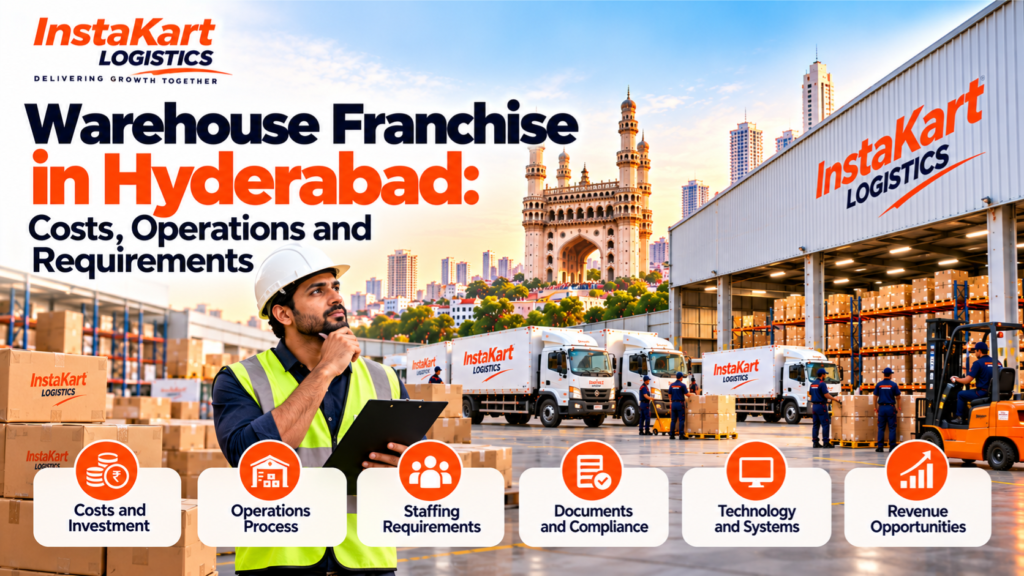
Warehouse Franchise in Hyderabad: Costs, Operations and Requirements

Warehouse Franchise in Hyderabad: Costs, Operations and Requirements Starting a warehouse franchise can be a promising business opportunity for entrepreneurs who want to enter the logistics and distribution industry. As e-commerce sellers, retailers, manufacturers, and wholesalers look for better ways to store and distribute products, the demand for organised warehousing and logistics services creates opportunities for businesses that can manage these operations efficiently. Hyderabad is worth considering because it serves a wide range of commercial, industrial, and distribution activities. However, starting a warehouse franchise involves more than renting a building and storing parcels. You need to understand the investment, daily operations, staffing, technology, customer requirements, and franchise terms before making a decision. In this guide, we will explain the costs, operations, and requirements of starting a warehouse franchise in Hyderabad, along with practical considerations to help you plan your business. 1. Understanding the Warehouse Franchise Business Model A warehouse franchise allows an entrepreneur to operate a warehousing or logistics-related business under an established company’s business model. Depending on the franchise agreement, your responsibilities may include receiving goods, storing products, sorting parcels, preparing orders, coordinating transportation, and managing dispatch. There are several types of warehouse operations you can consider: Each model has different space, staffing, equipment, and investment requirements. Therefore, identify the type of operation you want to run before deciding on a franchise. 2. How Much Does a Warehouse Franchise Cost in Hyderabad? The total investment depends on the size of the facility, its location, the services offered, and the franchise company’s terms. The following figures are illustrative planning estimates, not verified franchise quotations. Business model Indicative initial budget Small parcel-handling hub ₹3 lakh–₹8 lakh Small leased warehouse operation ₹8 lakh–₹20 lakh Warehouse with sorting and fulfilment ₹15 lakh–₹35 lakh or more Large-scale warehouse facility ₹35 lakh onwards These amounts may not include property purchase, major construction, or all franchise fees. Some models may require less investment, while others may require substantially more. Before proceeding, ask the franchisor for a complete breakdown covering setup costs, recurring fees, infrastructure, equipment, and working capital. 3. Warehouse Rental Costs in Hyderabad Location is one of the biggest factors affecting your budget. Hyderabad’s warehousing market includes established clusters such as Medchal, Patancheru, and Shamshabad. According to Cushman & Wakefield’s December 2025 market data, reported warehouse rents varied by submarket, with figures including approximately ₹21 per square foot per month in Medchal, ₹23 in Kompally, ₹25 in Patancheru, and ₹23 in Shamshabad. These are market benchmarks, not guaranteed quotes for individual properties. Cushman & Wakefield For example, consider a warehouse measuring 5,000 square feet. Illustrative warehouse rental calculation 5,000 sq. ft. Rent per sq. ft. per month ₹21–₹25 Estimated monthly base rent ₹1,05,000–₹1,25,000 Excludes security deposit, taxes, maintenance, utilities, and other property-related expenses. A smaller facility or a conventional godown may have different rental terms. Always compare actual property quotations and inspect the premises before committing to a lease. 4. Equipment and Infrastructure Requirements Once you have selected a suitable property, you need to prepare it for daily warehouse operations. Depending on your business model, the setup may require: A parcel-handling hub may not need the same equipment as a warehouse that stores thousands of individual products. Therefore, start with the essential equipment required by the franchisor and expand as your operational needs increase. 5. Daily Operations of a Warehouse Franchise Running a warehouse involves a series of connected activities. Each stage needs to be organised properly to prevent delays, misplaced parcels, and inventory errors. A typical workflow looks like this: 01 Receiving Accept incoming parcels or inventory and verify shipment details. 02 Sorting and recording Classify items and update the relevant tracking or inventory system. 03 Storage or order preparation Store products safely or pick and pack orders for dispatch. 04 Dispatch coordination Arrange transportation and assign shipments to the appropriate routes. 05 Tracking and reporting Monitor shipment movement, delivery status, and exceptions. The precise workflow depends on whether you manage storage, courier parcels, e-commerce orders, or a combination of services. 6. Staff Requirements Your staffing needs will depend on the facility’s size, working hours, shipment volume, and range of services. A small operation may need only a few people initially, while a larger warehouse may require dedicated teams. Common roles include: Avoid hiring more people than your business needs at the beginning. At the same time, ensure that staffing is sufficient to handle shipments safely and meet operational commitments. Training is equally important. Employees should understand parcel handling, inventory records, safety procedures, and the technology used in daily operations. 7. Technology and Inventory Management Technology helps warehouse operators manage information accurately and efficiently. Depending on the franchise model, you may need systems for: For example, when a business sends 200 parcels to a warehouse, the operator needs a reliable way to record the parcels, track their movement, and identify any shipments that have not been dispatched. Manual records may work for very small operations, but they can become difficult to maintain as shipment volumes increase. Before joining a franchise, confirm whether its software is included, whether training is provided, and whether additional technology fees apply. 8. Documents and Legal Requirements The documentation required for a warehouse franchise depends on your business structure, premises, and activities. Common documents may include: Depending on the premises and operations, you may also need to assess fire safety, building-use, employment, vehicle, and other compliance requirements. Not every registration applies to every warehouse. Verify your specific obligations with the relevant authorities or a qualified professional before starting operations. 9. How Does a Warehouse Franchise Generate Revenue? A warehouse franchise may earn revenue through several services, depending on its business model. Storage charges: Businesses pay to store products for an agreed period. Handling charges: Fees may apply for receiving, sorting, moving, or preparing inventory. Order fulfilment: The business may charge for picking, packing, and dispatching customer orders. Parcel processing: A warehouse that supports a courier network may earn through agreed parcel-handling or distribution arrangements. Transportation coordination: Some models include

Warehouse Franchise in Hyderabad: Costs, Operations and Requirements Read More »

Warehouse Franchise in Hyderabad

Who Can Start a Warehouse Franchise in Hyderabad?

Who Can Start a Warehouse Franchise in Hyderabad? Starting a warehouse franchise can be an interesting business opportunity for people who want to enter the logistics, storage, and distribution industry. As businesses grow, they need reliable ways to store products, manage inventory, process orders, and move goods to customers. This creates opportunities for entrepreneurs who can provide organised warehousing and logistics services. Hyderabad is an important commercial and industrial centre, making it a location worth exploring for warehouse-related businesses. However, you do not necessarily need years of logistics experience to begin exploring this opportunity. The more important questions are whether you have the right investment capacity, a clear understanding of the business model, the ability to manage daily operations, and a willingness to build relationships with business customers. In this guide, we will explain who can start a warehouse franchise in Hyderabad, what qualifications and resources may be helpful, and what you should consider before investing. 1. First-Time Entrepreneurs You do not necessarily need to have owned a logistics company before exploring a warehouse franchise. If you are new to business but willing to learn, you can start by understanding the franchise model, investment requirements, daily responsibilities, and customer demand in your preferred area. A franchise may provide training and operational guidance, depending on the agreement. However, you will still need to manage the business responsibly and follow the company’s procedures. This option may suit you if you: 2. Existing Business Owners If you already operate a business, a warehouse franchise could be an opportunity to diversify into logistics or distribution. For example, entrepreneurs working in transportation, courier services, wholesale trading, or e-commerce may already understand some of the challenges involved in moving goods. However, experience in one industry does not automatically mean that every warehouse model will be suitable. You should evaluate the additional investment, staffing, infrastructure, and management responsibilities before expanding. 3. Investors Looking for a Business Opportunity People who have capital available and want to invest in an operating business can also explore warehouse franchises. Nevertheless, a warehouse franchise is not necessarily a passive investment. Many models require active involvement in operations, customer acquisition, staff supervision, and financial management. If you intend to hire a manager to oversee daily activities, account for the additional salary and establish a reliable reporting system. Before investing, understand the expected responsibilities and avoid relying solely on projected returns. 4. Logistics and Transportation Professionals People who have worked in courier services, transportation, distribution, or supply-chain operations may find the transition easier because they already understand some industry processes. Their experience can help with: However, even experienced professionals should review the franchise agreement, financial model, and local demand before making a commitment. 5. E-Commerce Sellers and Retail Business Owners Online sellers and retailers often deal with inventory storage, packing, dispatch, and returns. Because of this, they may be interested in adding warehousing or fulfilment services to their existing business activities. For example, an entrepreneur who already sells products online may understand the importance of accurate inventory records and timely order processing. That experience can be useful when evaluating a warehouse franchise. However, operating a warehouse for external customers involves additional responsibilities, such as managing different clients’ inventory, service agreements, and billing. 6. People Who Own Suitable Commercial Property If you own a suitable commercial property or warehouse, you may already have one important resource required for this type of business. Depending on the franchise model, your property could potentially be used for parcel handling, storage, sorting, or fulfilment. However, ownership alone does not guarantee that the premises will be accepted. The property must meet the franchisor’s requirements and any applicable building, safety, zoning, and operational standards. If you plan to operate a regulated warehouse that issues negotiable warehouse receipts, additional registration and eligibility requirements may apply under the Warehousing Development and Regulation framework. Indian Kanoon +1 7. What Qualifications Are Required? For a typical warehouse franchise, the franchisor determines its own eligibility criteria. There is no single qualification requirement that automatically applies to every franchise model. A degree in logistics or supply-chain management may be helpful, but it is not necessarily mandatory. More important considerations may include: Some franchise companies may also require a particular business structure, premises, operational experience, or other conditions. Always confirm the specific criteria before applying. 8. How Much Investment Capacity Do You Need? Your investment capacity should match the type and size of warehouse business you want to operate. The budget may need to cover: A small parcel-handling hub will generally have different requirements from a large warehouse with storage racks, inventory management, and fulfilment operations. Rather than selecting a franchise based on the advertised entry fee, request a complete estimate of the initial and recurring costs. You should also retain sufficient working capital to manage expenses while building your customer base. 9. What Documents May Be Required? The exact documentation depends on the franchise company, your business structure, and the services you plan to provide. Commonly requested documents may include: For certain regulated warehousing activities, additional requirements may apply. Therefore, distinguish between the onboarding documents requested by a franchise company and the statutory registrations required for your specific operations. Indian Kanoon +1 10. Which Location Should You Consider in Hyderabad? The right location depends on your customers, service territory, transportation needs, and budget. Areas such as Medchal, Kompally, Jeedimetla, Patancheru, Pashamylaram, Shamshabad, and Kothur may be worth evaluating for different types of warehouse and distribution operations. Before choosing a property, consider: Do not sign a long-term lease simply because a property appears affordable. First, confirm that the franchisor accepts the location and that the premises are suitable for the intended business. 11. How to Decide Whether a Warehouse Franchise Is Right for You Before making a decision, ask yourself a few practical questions: If several answers are unclear, spend more time researching before committing your money. A warehouse franchise may offer a business opportunity, but it should fit your financial position, skills, and willingness to manage

Who Can Start a Warehouse Franchise in Hyderabad? Read More »